Tuesday, 26 January 2021

Happy Republic Day 2021


On this special day,

lets promise our motherland that
we will do everything
to enrich and preserve our heritage
our ethos and our treasure
Happy Republic Day. - GoITWay Team


Friday, 1 January 2021

Happy New year 2021


May Joy, Peace and Success follow you everywhere you go and whatever you do. Have a wonderful new year 2021. - GoITWay family.


Friday, 24 July 2020

Inpection of drain near Shri Ganesh Temple


Requested J.E. Walke to cover the drain with #Slabs and to prepare estimates opp the Ganpati temple on the roadside to facilitate better movement of vehicles.

Monday, 29 June 2020

Senitization drive Initiated at VP Nachinola

Village Panchayat Nachinola with the help of MLA Aldona Constituency, Shri Glenn Ticlo carried out Sanitization drive in the Village. A team of Fire Officers  sprayed Sodium Hypochlorite Solution mixed with water to disinfect the areas covering the major public places like Temples, Church, bus stops, Institutions, etc. 

GOA CM Strict on people not wearing face mask

People are hereby requested to maintain Social Distancing and Compulsorily wear face mask all the time.

Tuesday, 2 June 2020

Friday, 20 March 2020

Microsoft teases new Windows 10 UI in video celebrating a billion users - GoITWay

Microsoft’s Windows 10 operating system passed a billion active users earlier this week, and the company is now marking the occasion with a video that teases new features and UI changes. In an Instagram video from Windows and Devices chief Panos Panay, Microsoft has revealed it’s pushing ahead with changes to the Windows 10 Start menu that will see the company deemphasize its Live Tiles.

Microsoft is planning to reduce the color of the blocks of the tiled interface on the Start menu to simplify it and make it easier to scan for apps. This is shown in the video alongside what appears to be some spacing changes to how Live Tiles are displayed.

Microsoft also appears to be working on improving its Fluent Design system in Windows 10, with more modern context menus and even a new Files app. We’ve been waiting quite some time for a modern take on the Windows File Explorer, and this video teases that one is coming soon.

It also includes many of Microsoft’s changes to the Windows icons that the company has been rolling out recently. Built-in Windows 10 apps are gradually being updated with new and colorful icons ahead of a bigger effort to modernize the OS with Windows 10X for dual-screen devices like the Surface Neo.

The teaser video comes just days before Microsoft plans to unveil consumer subscriptions for its Microsoft 365 service during an online event on March 30th. Microsoft is expected to bundle Office, Microsoft Teams, a password manager, and some general consumer-focused features into a monthly subscription.

We at GoITWay are not expecting to hear anything about Microsoft’s upcoming Surface Book 3 or Surface Go 2 plans at the event, but there will likely be some news on the company’s plans with Windows for 2020 and beyond. Microsoft is also holding its Build developer event online this year, where we’ll hear more about Windows and Windows 10X for dual-screen devices.

-GoITWay


Tuesday, 20 November 2018

INTEL TO UNVEIL NEW HASWELL CHIPS IN SEPTEMBER

Intel's Haswell chips have been quite well-recieved. According to DigiTimes, Intel will be expanding its Haswell line-up with new processors in September. The report states that the company will be unveiling 13 new processors for desktops and 24 for notebooks.

Intel has separated its mobile processors in several categories, which includes the M series mainstream chips, H series high-performance chips and Y and U series for low power-consumption chips.

Despite its expansion of Haswell, Intel won't be abandoning its previous-generation Ivy Bridge chips. The company will be bringing out four Ivy Bridge chips in September. The company is also expected to unveil its Bay Trail T platform chips for tablets, M platform for entry-level notebooks and D platform for entry-level desktops.

Intel had launched its Haswell chips back in June. In contrast to the buzz regarding the launch, Intel has made relatively modest microarchitecture improvements with Haswell, especially when compared to Sandy Bridge and Ivy Bridge release, which is the name given to 22nm shrunk die of the Sandy Bridge microarchitecture based on 3D transistors.

The release was in line with Intel’s ‘tick-tock’ product development and release strategy adopted since 2007. Every 'tick' is a shrinking of process technology of the previous microarchitecture and every 'tock' is a new microarchitecture. Intel’s Sandy Bridge microarchitecture, introduced in early 2011, was a ‘tock’ built using a 32nm manufacturing process, the Haswell release too is a ‘tock’ and it uses the 22nm manufacturing process as Ivy Bridge.


GoITWay

Monday, 29 October 2018

Data & cyber security may come under Trai, Telecom Commission

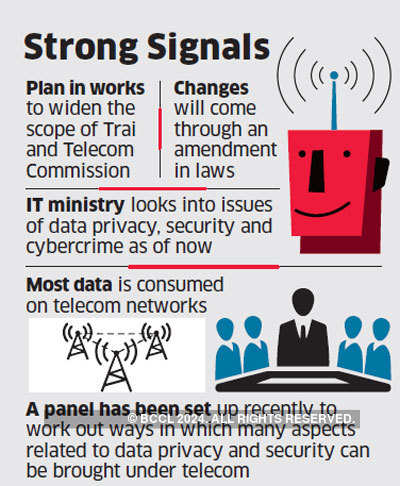
MUMBAI: The remits of the telecom regulator and the Telecom Commission are in the process of being widened that may see them overseeing issues such as data privacy, security and cybercrime, which are currently being looked into by the IT ministry, people familiar with the matter said.

According to officials in the Department of Telecommunications and the Telecom Regulatory Authority of India (Trai), these changes, which will come through an amendment in laws, underline the fact that consumers access most of their data via mobile phones, and hence the telecom department will need to get involved.

“We have to realise that subjects such as data privacy and security all flow through the telecom network. In fact, 93% of all such data is consumed on telecom networks, for example ecommerce, etc,” said a senior government official, who did not want to be named.

“Aspects of data privacy etc should all come under one ambit, and that should be the Digital Commission and the Digital Communications Regulator,” the official said.

Any change in the regulatory ambit of one of the two institutions — the Telecom Regulatory Authority of India (TRAI) or the TC — needs to be complemented by a similar widening of the scope of the other. This, since all of the regulator’s recommendations need to be cleared by the Telecom Commission (TC).

Recently, the cabinet approved renaming the Telecom Commission to the Digital Communications Commission (DCC) while industry watchdog Trai became Digital Communications Regulatory Authority of India. “These cannot be just name changes. One needs to keep in mind that this will be the policy of the government, not of any ministry. Some changes need to be made in the remit of the Digital Commission and the Trai Act as well. It’s a work in progress,” said another senior official of the telecom ministry. Currently, the TC—an inter-ministerial body, which is the highest decision-making authority of the DoT—is headed by the telecom secretary.


The full-time members of the commission are member (finance), member (production), member (services) and member (technology). Part-time members of the TC are CEO of Niti Aayog, secretary (Department of Economic Affairs), secretary, ministry of electronics and information technology (MeitY) and secretary (Department of Industrial Policy & Promotion). The TC was set up via a government resolution in 1989. Trai, on the other hand, is governed by the Trai Act of 1997.

An inter-ministerial team was formed three months ago which is working on ways in which many aspects related to data privacy and data security are moved under telecom, said another DoT official. The official added that the team of experts includes officials of MeitY and the ministry of information and broadcasting (I&B).

“We have instructions from the top officials in the government to see how all privacy and datarelated issues can be seamlessly looked into under the governance of TC,” the official said.

A senior Trai official also confirmed that meetings are on and this would also lead to additional responsibility for the sector regulator, which currently regulates all matters related just to the sector, with consumer interests at the heart of its actions. “The jurisdiction of TC will increase keeping cybercrime in mind. It is still in the planning stage but talks are on to ensure that all the work that is done by DoT in dealing with data safety is put forward,” said another official aware of the developments.

The government plans to table the draft personal data protection bill submitted by Justice BN Srikrishna Committee in Parliament by December after holding consultations with different ministries, industry representatives and the public.

The bill, submitted to the IT ministry, recommends a layered consent architecture and bringing in key principles of personal data processing, whereby companies should collect only the required data from an individual, state the purpose of its use explicitly, and store it only for as long as it is required.

As per the draft bill, citizens and internet users will have the final say on how and for what purpose personal data can be used, and they will also have the right to withdraw consent.

The Trai, on its own, in mid-July had released its recommendations on the subject titled ‘Privacy, Security and Ownership of Data in the Telecom Sector’, which are applicable for apps, browsers, operating systems and handset makers.

-GoITWay

Saturday, 27 October 2018

Fake bank apps may have stolen data of thousands of customers: Report

Fake apps of SBI, ICICI, Axis Bank, Citi and other leading banks are available on Google Play, which may have stolen data of thousands of bank customers, claims a report by IT security firm Sophos Labs.

These fake android apps have logo of respective banks which makes it difficult for customers to differentiate between the fake and original apps, it said.

The report further said that the deceptive malware in these apps may have stolen thousands of customers' account and credit card details.

When contacted some of the banks mentioned in the report said they have not come across any such fake apps.

However, some banks have started inquiry and also informed the CERT-In -- the national nodal agency for responding to computer security incident.

The fake apps target total seven banks like SBI, ICICI, Axis, Indian Overseas, BoB, Yes Bank and Citi Bank, the report said.

Another lender Yes Bank said it has informed the bank's cyber fraud department about the matter.

However, the country's largest lender State Bank of India's response was awaited.

There were no immediate comments from ICICI Bank and Axis Bank.

According to the report, the apps lured victims to download and use them, either by masquerading as Internet apps or e-wallets, promising rewards, including cash back on purchases, free mobile data or interest free loans.

Some even claimed to be providing a too-good-to-be-true service, enabling users to withdraw cash from an ATM and have it delivered to their doorstep.

"Deceptive malware may have stolen thousands of Indian sub-continent bank customers account data or credit card numbers," said Pankaj Kohli, threat researcher, SophosLabs.

Fake apps are not new to Android and this sort of malware will continue to find its way into the android app store, it said.

"Some are blatant copies of real apps, while a few are much more dangerous as they seed malware and steal data from user accounts. Users should always use antivirus software, which provides malware protection and internet security to keep users protected and stop these fake apps from stealing data," it said.

Friday, 26 October 2018

AI will cause role changes, not necessarily job losses: Studies

More than half of generic work profiles are facing the risk of disruption over the next two years due to automation, according to an estimate by Teamlease Services.

However, this does not necessarily imply job losses as automation would throw up new job profiles for those getting substituted, experts said.

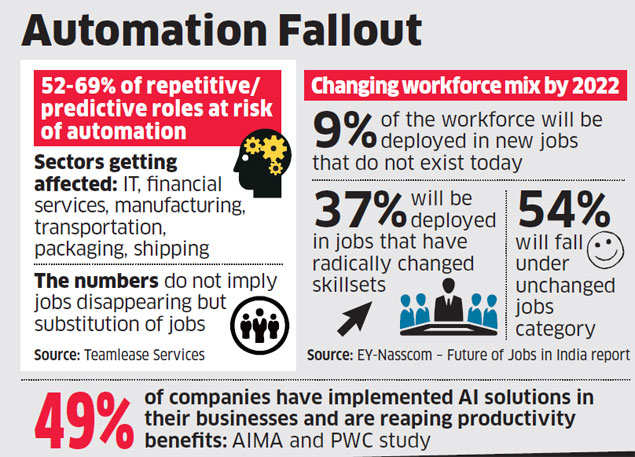
A Teamlease Services study, based on data from secondary sources, estimates 52-69% of repetitive and predictive roles in sectors including IT, financial services, manufacturing, transportation, packaging and shipping to get exposed to the risk of automation in the next couple of years.

“The data implies risk of automation. However, that does not mean it would lead to a job loss necessarily,” said Rituparna Chakraborty, co-founder of Teamlease Services, discrediting the oft-quoted premise that automation would lead to job loss.

“There’s a nuance that most people lose out on—jobs disappearing and substitution of jobs,” said Debabrat Mishra, partner at Deloitte. “This is not the first time we are witnessing the impact of technology and automation. For example, ATMs were supposed to do away with cashiers (at banks) but both coexist today. In fact, ATMs created more jobs in the backend in the form of call centres,” he explained.

Though employment-related concerns due to automation cannot be altogether ruled out, it would allow humans to get more involved in tasks that need higher specialisation and critical thinking, experts said.

As much as 49% companies that responded to a recent survey by the All India Management Association (AIMA) and PwC on how artificial intelligence is reshaping jobs said they had implemented AI solutions in their businesses and were reaping productivity benefits.

Roles getting rapidly disrupted include data-entry clerk, cashier, financial analyst, telemarketer, customer-service executive, manual work operator/executive, factory worker, computer support specialist, market research analyst, retail salesperson and advertising sales person.

However, several of the people getting replaced by automation will find higher-value-added jobs, said experts. Mishra qualified the substitution of jobs predicted as disruption. For instance, the role of a data-entry clerk will be taken over by machines but the role will be substituted by a data-validation clerk.

A cashier’s role would be substituted by a query handler, a financial analyst by an adviser, a telemarketer by a personal adviser or marketing algorithm builder, a customer service executive by a customer interaction executive and a retail salesperson by a retail adviser, style adviser or shopping assistant.

The AIMA survey stated that as AI systems continue to disrupt traditional industrial practices with their increasing prowess at tackling complex problems, they continue to raise employment-related concerns.

While 36% of decision-makers stated that overall, advancements in automation and technology had not displaced jobs, 46% said these would have a severe impact on employment in India. Further, nearly half the participants surveyed felt job automation was reasonably probable; however, it was likely to be partial, with humans retained for specific expertise.

“Based on the views of professionals working across different industrial sectors, we can conclude that most of the sectors are likely to be partially automated, but the chances of complete automation in the next five years are the highest in the manufacturing sector (38%), followed by the finance sector (31%),” the survey stated.

“There will be some impact on jobs in the short-term and jobs will not grow in massive numbers. However, in the next five years or so, the impact will even out as there will be new job creations and role substitutions,” said Pankaj Bansal, chief executive at PeopleStrong.

Salary levels will go up due to specialisation of skillsets and the acute dearth of talent qualified in new capabilities in India and the world over, he said.

According to a survey on the Future of Jobs in India by EY and Nasscom, there will be a change in workforce mix by 2022 due to increased adoption of technologies. By then, 9% of the workforce will be deployed in new jobs that do not exist today, 37% will be in jobs that have radically changed skillsets and 54% will fall under the unchanged jobs category.

Experts also stated that the impact of automation is no longer restricted to junior and middle level as creation of new categories of businesses is leading to senior-level jobs being redesigned with rapid adoption of AI, robotics, blockchain, etc. One recent instance of this was seen a couple of weeks ago, when Cognizant Technology Solutions let go of 200 employees at the senior level.

This was part of the company’s plan to align its talent pool to new digital requirements, replacing those who have not adopted to the new technology landscape with those with new skills.

“Organisations need the senior leadership positions to support these requirements—which could either happen through senior leadership upskill and leadership ability changes or hiring talent from outside,” said Anurag Malik, partner at EY.

The good news is that while technology is making inroads at a rapid pace and as new job profiles get created, there is an increasing demand for professionals trained in new skills who can help companies navigate through the transformation.

-GoITWay

Wednesday, 24 October 2018

Hackers have found a new way to sneak into computers and it’s through our own body heat.

Researchers at University of California found a new way of hacking, which is through a person’s own heat left by their fingers. When someone types in a password on their keyboards, they leave heat traces behind that are later picked up by hackers.

Naming the technique ‘Thermanator’, the team discovered this by using a thermal imaging camera and scanning the computer keyboard after a password has been typed. They noticed that key presses can be recovered as late as 30 seconds after the first key was pressed, reported Digital Trends.

Publishing their findings in a paper Thermanator, the researchers wrote, “Although thermal residue dissipates over time, there is always a certain time window during which thermal energy readings can be harvested from input devices to recover recently entered, and potentially sensitive, information.”

This style was tested by 31 participants on four keyboards and full passwords can be gained by scanning thermal residues on keyboards after 30 seconds. After a minute passed by, partial passwords were obtained. For the tests, the infrared heat-detecting FLIR cameras were set on tripod 24-inches away from the keyboard.

Thirty non-expert users were made to guess the password based on the scans. The participants were able to guess passwords between 19.5 and 31 seconds after the first presses. Weak passwords were guessed in an average of 25.5 seconds whereas passwords like ‘12341234’ took 45.25 seconds to guess.

“The main takeaway of this work is three-fold. First is using external keyboards to enter (already much-maligned) passwords is even less secure than previously recognized, second is to post factum (planned or impromptu) thermal imaging attacks are realistic, and finally perhaps it is time to either stop using keyboards for password entry, or abandon passwords altogether,” researchers said.

Researchers said that this type of attack could be used to gain access to text, banking pins, and/or codes. They hope that their findings will encourage a move towards more secure methods, wrote Mirror.


GoITWay

Tuesday, 23 October 2018

Facebook logs in, Bengaluru now hosts all big five tech firms

Facebook is taking up 2.2 lakh sqft office space in Bengaluru as the world’s largest social network is logging into the country’s technology capital, people familiar with the matter said.

It has taken up the space in Embassy Golf Links, an office parkthat houses marquee clients IBM, Microsoft, Goldman Sachs and reinsurer Swiss Re, among others.

The city’s booming commercial market will now house all the Big Five tech firms — Facebook, Amazon, Apple, Microsoft and Google — or FAAMG, an acronym coined by Wall Street investors.

Sources told TOI that Facebook is expected to move into the new facility next year and will employ 2,200 people. The exact nature of operations is not clear immediately. The social network giant will pay a rent of Rs 130 per sqft, or Rs 34 crore a year, sources added. An email sent to Facebook didn’t elicit a response. Embassy Office Parks declined comment.


Monday, 22 October 2018

All about India's data localisation policy


Several laws and regulators are converging on the hotbutton topic of data localisation. The deadline for a Reserve Bank of India (RBI) mandate for fintech firms to house data only in India lapsed last week. Other norms around holding accounting data dating back to 2014 locally, the draft ecommerce law that requires firms to locally store “community data collected by Internet of Things devices in public space” and “data generated by users in India from various sources including e-commerceplatforms, social media, search engines, etc,” only queer the pitch further.

What’s At Stake
There’s a massive explosion in data being generated by connected internet users in India. According to a report by real estate and infrastructure consultancy Cushman and Wakefield, the size of the digital population in India presents a huge potential demand for data centre infrastructure.

Digital data in India was around 40,000 petabytes in 2010; it is likely to shoot up to 2.3 million petabytes by 2020 — twice as fast as the global rate. If India houses all this data, it will become the second-largest investor in the data centre market and the fifth-largest data centre market by 2050, the consultancy has forecast.

Reactions Of Companies
Large tech companies are unhappy with such restrictive laws. Google’s privacy chief Keith Enright said in a recent blog post: “Mechanisms allowing for cross-border data flows are critical to the modern economy. Countries should adopt an integrated framework of privacy regulations, avoiding overlapping or inconsistent rules whenever possible.”

Indian Firms, Especially Startups, Are For It
Their push is from a data security angle and to safeguard India’s homegrown ventures. Companies such as Paytm and Phonepe have strongly endorsed data localisation, with a blog post from the latter contending that this move would “allow for better regulatory oversight and plug businessjurisdiction related loopholes that some foreign companies have long exploited to evade paying fair taxes in India.”

Issues Remain
Companies want to store, process and analyse data from multiple geographies. Some companies and lawyers argue that restricting the free flow of data may be counterproductive. “Excluding all Indian payment data from transfers is onerous, expensive, and can potentially limit the functionality which is currently available,” says Arun Prabhu, partner, Cyril Amarchand Mangaldas.

Now, A Trade Issue
While the tussle over data localisation started off within India, intense lobbying by tech MNCs has meant that this issue has now snowballed into one relating to free trade. Dennis Shea, the US ambassador to the WTO, has called for the banning of data localisation, even as US Senators John Cornyn and Mark Warner have called for India to soften its stance on the subject, according to a Reuters report.

Does Location Matter?
Technology experts such as Prashant Pradhan, vice-president and CTO (Asia Pacific) of IBM, argues that the physical location of data is irrelevant. Your data can be accessed from a server in Bengaluru or Boston just as easily. In fact, having a mirror of your data in India may actually increase the cost of operation and compliance. What’s more important is the quality, rather than sheer quantity. While terms such as big data were in vogue previously, what companies may be more interested in now is the quality of data they can secure and store. “While the amount of data itself has grown, what isn’t well understood is who has access to this data and what they can do with it,” he says.

Regulations Around The World
The European Union's General Data Protection Regulation doesn't have a specific data regulation rule, only stressing that cross-border data movement can happen if the other country has stringent rules to secure information. Several other countries have operationalised had various shades of data localisation.

Nigeria has, for example, required all subscriber and consumer data of tech and telecom firms and government data to be located locally, since 2013. Germany mandates that telecom and internet service providers store data locally, while Russia¡¦s rules mandate citizen data be stored within its borders.

However, by far, the most comprehensive laws are in China, where regulation covers not just personal information, but what is termed ¡§critical information infrastructure¡¨ that encompasses all aspects of daily life. Legal experts also say that the broad terminology paves the way for overt government access to this data and to build a strong cyber sovereignty.

Saturday, 20 October 2018

H-1B visa tweak may hurt IT firms

The Donald Trump administration has proposed changes to the H-1B registration process, which could lead to more permits being given to those with US master’s degrees, impacting Indian IT firms that rely on the work visa to service clients in that market.

The US General Services Administration said in a note that it was looking at a modified selection process in tune with the ‘Buy American and Hire American’ policies of the US government in a rule that was first proposed in 2011 to improve the intake and selection process of H-1B petitions. The US Citizenship and Immigration Services (USCIS) is the agency mandated to issue visas to immigrants.

“This regulation…would increase the probability of the total number of petitions selected under the cap filed for H-1B beneficiaries who possess a master’s or higher degree from a US institution of higher education each fiscal year,” it said. The US offers 65,000 standard H-1B visas for skilled workers and an additional 20,000 visas for workers with a US master’s degree or higher.

Typically, the agency processes the master’s pool and then sends petitions that are left over to the general pool. “Under the proposed rule, USCIS would first put all applicants in the general 65,000-visa pool. If that cap were reached, any additional US advanced degree holders would be redirected to the 20,000-visa pool,” US political news site Politico reported, citing sources at the Department of Homeland Security. “The administration expects the change could lead to a 15% increase in H-1B visa holders with US advanced degrees.”

For Indian IT companies, which predominantly employ people with bachelor’s degrees, the move could reduce the number of visas that are available for those without the advanced degrees. Some companies are already facing margin challenges as a result of tighter visa rules that require them to hire US citizens and sub-contract work when they cannot hire quickly enough.

“Increase in our sub-contractorcost, on-site localisation and investment impacted the margins by 50 basis points,” Infosys told analysts after its second-quarter results. The company’s margin was flat even as the rupee weakened significantly, which generally results in higher margins.

The company said it expects its sub-contractor costs to remain elevated, until it could staff projects with its own employees. Last year, Infosys said it would hire 10,000 American workers by 2020.

Despite the issue of tighter visas, IT CEOs do not believe the Indian talent model will fade away soon. “The fact is that the sheer demand for talent and the supply for talent is going to be met from places like India because demand far outstrips supply in those markets. But we have to be cognisant of the politics of it, so we need to be broad-based,” TCS CEO Rajesh Gopinathan said in an interview last week. “But I don’t think the demand for Indian talent is going to be outdated anytime soon.”

The US has issued over 19.07million of the 34.7 million H-1B visas issued in the decade to 2017 to applicants with post-graduation qualifications, the USCIS disclosed on its site. It did not, however, disclose whether the applicants had advanced degrees from US universities.

During the same period, those with bachelor’s degrees got 15.43 million work permits. The Trump administration is also looking to terminate by end of this year an Obama administration plan that allowed spouses of H-1B visa holders to work in the US.

The National Association of Software and Services Companies (Nasscom) said the Trump administration had said last year that it would begin making these changes to the programme and that the industry lobby would only be able to comment once an actual change was made. “We have always maintained that changing regulatory issues relating to the employer-employee provision, or the wages would simply increase the costs to the US companies that use the services of the industry to innovate and grow,” said Nasscom vice-president Shivendra Singh.

Thursday, 18 October 2018

RBI Wants to Enable Seamless Transfer Between Mobile Wallets Using UPI


The Reserve Bank of India on Tuesday laid out guidelines that would allow for seamless payments between different mobile wallets, in a move that could further boost the use of digital payments in the country.

Mobile wallets such as the one run by SoftBank and Alibaba-backed Paytm have become popular in India after a ban on high-value currency in late 2016 pushed people to pay digitally. Mobile wallets currently do not allow users to send or receive money from a wallet run by another firm.

Digital wallet companies, if they so desire, can now use a state-backed payments network UPI that makes peer-to-peer payments instant, to make wallets inter-operable, the Reserve Bank of India said on Tuesday.

"It's going to increase the growth rate of digital payments in India even faster and, of course, create more business opportunities," said Upasna Taku, co-Founder of fintech firm MobiKwik, which operates a wallet.

Digital payments in India are projected to grow five-fold to about $1 trillion (roughly Rs. 72 lakh crores) by 2023, according to Credit Suisse.


Huawei launches machine learning chips to power AI strategy


Huawei has unveiled an AI strategy and a portfolio of supporting products built on two new microchips, which the telecoms giant claims is the world’s first AI IP and chip series designed for a full range of deployment scenarios.

The Ascend 310 is designed for the low-power computing needs of smart devices and the Ascend 910 for cloud computing. Huawei’s rotating chairman Eric Xu said the Ascend 910 has “greatest computing density in a single chip,” but denied that it was designed to provide direct competition for the likes of Qualcomm and Nvidia.

Huawei’s full-stack portfolio of AI products and cloud services. These are designed to adapt to public clouds, private clouds, edge computing, industrial IoT devices, consumer devices, and any other deployments, providing optimal efficiency for any scenario, whether the priority is minimising energy consumption or maximising computing power.

“‘Full stack means that Huawei is able to provide AI application developers with unparalleled computing power and a strong application development platform,”


Huawei’s AI strategy

Huawei has historically focused on building chips for its smartphones but is now developing them to power other enterprise applications.

Huawei’s AI strategy aims to increase adoption by offering faster model training, affordable computing power, AI deployment and user privacy, new algorithms, AI automation, practical applications, a real-time, closed-loop system, multi-tech synergy, platform support and talent availability, according to the company.

The products that will support these objectives include the Ascend chips series, a chip operators library and development toolkit, a training and inference framework, and application enablement for devices, edge and cloud computing through full-pipeline services, hierarchical APIs and pre-integrated solutions.

In September 2017, Huawei released Huawei Cloud EI, an AI service platform for enterprises and governments. In April 2018, Huawei announced HiAI, its AI engine for smart devices. The company’s full-stack, all-scenario AI portfolio is designed to provide powerful support for Huawei Cloud EI and HiAI.


-GoITWay

Wednesday, 17 October 2018

What is inventory management? A system for streamlining operations


What is an inventory management system?

An inventory management system tracks purchases, keeps count of goods and supplies in stock, and reorders supplies when levels get low. More sophisticated inventory management systems can track stock location and will even predict the optimum time to reorder supplies, drawing on a variety of data, including past sales and weather forecasts.

Inventory management systems integrate with — or may potentially replace — purchasing and sales systems, and they provide tools to reconcile stock levels calculated from purchasing and sales with real-world counts taken from warehouses via barcode scanners or RFID readers.

There are small business inventory systems you can run on a single PC, bigger software suites that run on premises or in the cloud, and inventory management modules for enterprise resource planning (ERP) systems.

Inventory management vs. ERP

In tracking inventory, an inventory management system provides a subset of the functionality of an ERP system, which also takes orders from customers, bills them, places orders with suppliers, pays them, pays your staff, and reports on how your business is doing. As such, inventory management is just one of the modules in a typical ERP system. That module may be enough, depending on the size of your ERP vendor and how much they know about the market you’re in, or you may want to turn to a specialist inventory management software vendor.

The benefits of inventory management software

If your business buys and sells goods and materials, inventory management can provide an essential overview of your operations, beyond simply tracking what you’ve bought and what you’ve sold. A good inventory management system can benefit your business by ensuring that you never have to tell a customer you’re out of stock, which can hurt your sales and reputation. An inventory management system can also help minimize levels of raw materials, work in progress and finished goods, enabling your organization to avoid tying up capital in unnecessary stock and save on warehousing costs by renting just enough space and no more.

Tracking how long perishable — or fashionable — goods typically hang around in your warehouse can also save you money, enabling you to limit stocks to just what you can sell before they go out of date or out of style.

Plus, inventory management isn’t just a good idea, it’s the law: Disclosing total inventory is a financial reporting requirement in many jurisdictions.

How does inventory management software work?

At its simplest, inventory management software adds up stock as it comes in and subtracts what gets sold, stolen or discarded. To ensure you don’t run out of stock, or space to store it, the software will make forecasts about how quickly stock will go out the door, and how long it will take to get new stock in, based on past performance data, such as recent sales, seasonal sales performance, and how long it typically takes your suppliers to deliver.

More sophisticated systems can use additional factors — weather reports, store schedules, anything you can turn into a number — to fine-tune those forecasts.

Inventory management features

An inventory management system can offer a lot more functionality than simply counting your inventory, depending on how much you're willing to pay, where you're running it, and what other applications you're willing to integrate with it.

Scanning barcodes is almost a given these days, even at the corner store, allowing the software to automatically update stock levels from the point of sale. Processing RFID tags takes things to the next level, allowing you to track not just which product, but which instance of a product, has been shipped or sold.

The software may be able to generate reports on inventory variations or forecast seasonal demand, allowing you to order raw materials and plan production to maximize sales. It may also automate elements of your business, automatically reordering when stock levels run low — especially useful for irregularly selling items you don't pay much attention to — and generating purchase orders and invoices, perhaps by integrating with your accounting software.

If you take orders or prepare estimates for clients on site, you'll want remote access to your inventory so you can promise realistic delivery dates: A system with a tablet or smartphone interface is a must.

The ability to track inventory across multiple locations is important if your company has warehouses around the country or makes intra-company sales.

Finally, an inventory management system that can perform "kitting" will make it easier for you to track the whole bills of materials for a finished product, whether it's a car or just the deluxe widget kit (complete with widget, spare battery and cleaning cloth).

Inventory management offerings

It needn't cost the earth to start managing your inventory. If your needs are modest, then there are free cloud systems out there that can help.

Delivrd, for example, will manage up to 10 product lines at a single inventory location. Pay $49.99 per month to manage unlimited products at unlimited locations, or twice that to integrate it with your e-commerce or order-picking systems.

Also in the cloud, Zoho has added an inventory management module to its CRM and collaboration platform. It offers features such as kitting and automatic reordering for free, but if you want to process more than a handful of orders a week or get a centralized view of multiple warehouses, you'll have to pay anywhere from $29 per month (for 10 users and 100 online orders) to $249 per month (for unlimited users and 30,000 online orders).

There are open source systems too, typically modules within broader open source ERP systems such as OpenBravo, Apache's OFBiz, or Odoo. OpenBravo and Odoo charge for support services around their software; Apache leaves that to third parties.

Further up the scale, several major enterprise software vendors also offer inventory management for their platforms. For example, Oracle Inventory Management integrates with the company's purchasing, manufacturing and supply chain software, and is available in the cloud or on premises. SAP offers many inventory management functions in its sprawling ERP system, and with its move to the S/4HANA in-memory platform much of that inventory analysis can be performed in real time.
AI in inventory management

Predictably, artificial intelligence is being used to enhance predictions or check that inventory records match reality. It’s being used to spot trends in what sells when, identifying the perfect weather for barbecue, and to improve inspection of goods in, ensuring orders match deliveries.

For more on the use of AI in inventory management, see “How AI will revolutionize inventory management.”

IoT in inventory management

Inventory management is fertile territory for the internet of things (IoT) to grow. Goods are now routinely tagged with RFID, allowing machines to track not only how much stock is on hand but where it is with ever-increasing precision. But the falling cost of sensors is making it easier to record not just where something is, but at what temperature it’s been stored and how hard it’s been dropped, at an increasingly granular level.


-GoITWay

Google may open eStore by November in India

Google is eyeing the e-commerce market in India. Except, it won’t be doing any direct commerce there.
Come November, Google plans to launch an online storefront for all its branded hardware products, ET has learnt. These would include its flagship smartphone Pixel, Chromecast, Google Home smart speakers, and virtual reality headset, Daydream.

The storefront, similar to Apple’s storefront for the India market, will be a website where Google will merely display its branded and licensed hardware products. But it will also be able to gain access to customer data and have a stronger influence over the buying experience.
“We are looking to launch a Google-branded online store for all hardware launched in India, with an authorised partner who will operate and manage the fulfilment,” a company spokesperson confirmed in an emailed statement.
Google, sources say, is in talks with several third-party partners for this, including Ingram Micro.

“A storefront allows Google to access info on the premium users looking to buy its phones. Second, it also helps the brand to control the end-to-end selling experience and have the ability to cross-sell other products and offerings, like bundling Google Home or accessories, or even, in the future, extended warranty plans or upgrade programs like Apple does well with Apple Care,” said Neil Shah, partner at Counterpoint Research.
In 2017, Google’s market share in India was 0.07% of the overall smartphone market, while in the premium category (smartphones above $600), it was 3%, according to market research company Counterpoint Research. In the first nine months of 2018, those numbers fell to 0.03% and 1.6%, respectively.

Google’s move comes at a time when other smartphone companies such as Samsung and Xiaomi have been coming up with their own ecommerce offerings. Manu Jain, the country head of Xiaomi, in an earlier interaction with ET had stastated that Mi.com, the company’s ecommerce website, had become “the third-largest (ecommerce website) in India” in terms of overall gross merchandise value (GMV), a proxy for gross sales.

Google’s pre-launch version of its India storefront (store.google.com) allows users to find both online and offline retailers where they could purchase its products from. That will change in November, with users getting an option to purchase, with a redirection to the partner’s page, upon which the transaction can be completed. This is unlike Google’s home market, the United States, where Google’s store is managed and fulfilled by the company.

-GoITWay